
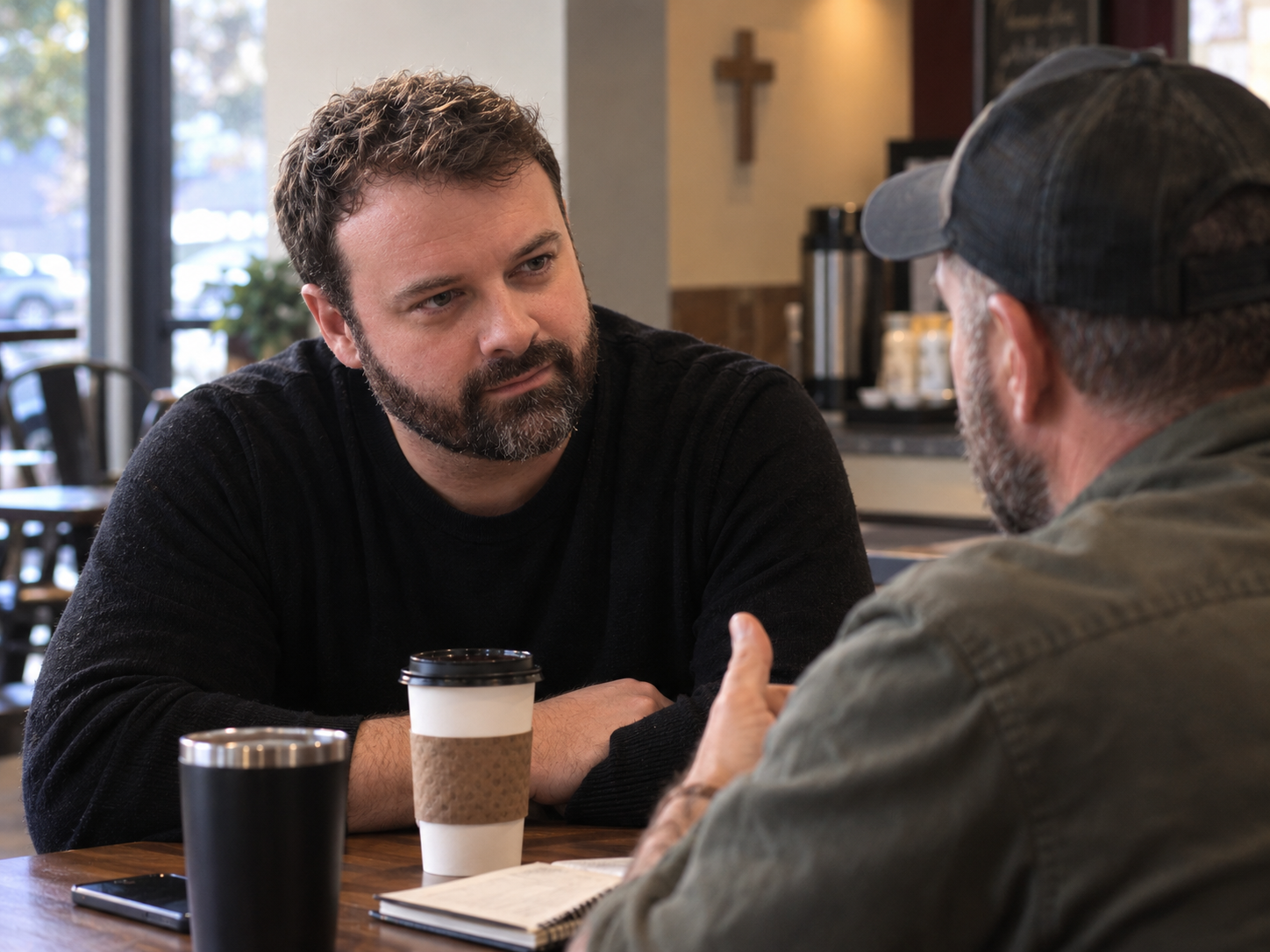
Learning how to lead your family begins with truthful language, patient compassion, and authority kept within its proper bounds.
The short version
Scientific uncertainty about violence demands restraint, while moral questions about sex and the body still require clear answers.
Criminal accusations belong in court, and guilt belongs to the individual whose conduct the evidence proves.
People experiencing gender dysphoria deserve dignity, patient listening, and protection from collective blame.
A man prepares to lead by speaking truth gently, hearing pain patiently, and keeping conviction rooted in God’s created order.
The Department of Justice put $1 million on the table and wrapped it in the language of a grant committee. The Oct. 9 notice asks researchers to examine possible ties between gender dysphoria and violent crime, producing what the agency calls “actionable knowledge” for law enforcement.
If a federal notice ever promises actionable knowledge, secure the dry erase markers. Government has a rare talent for putting a lanyard on confusion and assigning it a breakout session.
The subject itself deserves a straighter face. The National Institute of Justice says the available empirical evidence is limited, especially regarding underlying causes. Its proposed research includes retrospective analysis of diagnosed or self-identified gender dysphoria, treatment, violent behavior, post-conviction records, victim and offender overlap, mental health issues, and substance abuse disorders.
That sounds responsible. Measure first. Test assumptions. Separate public fear from evidence. Avoid turning a disturbed person’s identity into an indictment of everyone carrying the same label.
The man arguing against me deserves the first several rounds because he has a strong hand. He says families should leave technical questions to researchers, courts, clinicians, and law enforcement. He says fathers, mothers, pastors, and neighbors lack the data to pronounce on complicated questions of identity, diagnosis, treatment, and violence.
For a while, he is winning.
The Folder on the Table
His opening argument is simple: the Department of Justice admits the evidence is limited. A $1 million research effort exists precisely because certainty has outrun knowledge.
That matters. A man who sees one shocking crime and assigns collective guilt has surrendered his judgment to adrenaline. He has taken a defendant, an accused person, or a perpetrator and turned that individual into a demographic spreadsheet. Human beings deserve better treatment than that.
A February school shooting in Canada left the perpetrator, two family members, and eight other victims dead. Those deaths belong first to the people who were killed and to those who loved them. They should never become stage furniture for a cultural debate.
The perpetrator bears responsibility for the attack. A population category does not.
My opponent taps the DOJ notice. He points to the agency’s interest in other mental health conditions, substance abuse disorders, treatment histories, and overlap between victimization and offending. He says those variables matter because violence rarely arrives with one clean label attached.
He is right.
Federal charges involving a transgender Washington resident accused of aiding the teenager behind the Canadian shooting remain charges. The Department of Justice and Alabama officials also accused two transgender leftists in September of gun crimes and threatening communications. One allegedly posted death threats against immigration agents. Members of the transgender-led group called the Zizians face charges around the country in connection with murders and other offenses.
Courts determine guilt. Evidence belongs in courtrooms, where claims face rules, records, counsel, and scrutiny. Social media mobs prefer a folding chair and a match.
A criminal charge tells us what the government alleges about an individual. It supplies no license to condemn a class of people.
My opponent has me pinned there. Fairly, too.
Certainty Can Wear a Costume
He moves to his second point. Families get into trouble when confidence masquerades as competence.
I know that costume. I have worn it. Give me a firm opinion, a legal pad, and twelve uninterrupted minutes, and I can look remarkably qualified in subjects where my actual expertise would fit inside a paper clip.
The National Institute of Justice wants retrospective, secondary data analyses. Those words signal a specific kind of work. Researchers will examine existing records and relationships among variables. The Oct. 9 notice asks applicants to propose the research. It offers no completed finding that gender dysphoria causes violence.
That distinction is essential. Public conversation has a nasty habit of taking a government question and promoting it into a government answer. A grant announcement becomes proof. An inquiry becomes a verdict. A possible association gets shoved into the same sentence as causation, usually by someone whose statistical education ended around the time he discovered the percentage button on a calculator.
My opponent says moral leadership requires intellectual restraint. A father speaking to a child, a man advising a younger friend, or a leader addressing employees should refuse claims the evidence cannot support.
Again, he is right.
The DOJ seeks information about prevalence, diagnosis, treatment, post-conviction histories, and related conditions. Every one of those questions carries complications. How are people identified in records? Which diagnoses were formal? Which identities were self-described? What treatment occurred? Which other conditions were present? What counts as violent behavior? Which records are complete?
I do not know the answers. Neither does the loudest man in the locker room, though he often presents his conclusions with the calm authority of Moses holding two stone tablets and a podcast microphone.
Humility has a place here. So does precision.
When a man speaks about people experiencing gender dysphoria, he speaks about human beings. Some are suffering. Some are frightened. Some carry wounds nobody else sees. Some have been mocked. Some have been manipulated by activists and institutions. Some have found communities that offer belonging while demanding agreement with every ideological claim attached to that belonging.
Each person remains an individual. Each deserves compassion. Each remains morally accountable for his or her conduct.
My opponent leans back. His position looks sturdy because it is sturdy. Leave causal research to researchers. Leave prosecutions to prosecutors. Leave verdicts to courts.
I grant him every inch of that ground.
The Grant Cannot Raise a Child
Then the argument turns.
The DOJ’s $1 million inquiry addresses violence, diagnosis, treatment, and law enforcement. It cannot tell a household what a man is, what a woman is, what the body means, or whether compassion requires agreement.
Those are moral questions. Every home answers them, including the home that avoids them.
My opponent has confused two categories. He treats scientific uncertainty about violence as a command for moral silence about identity. The National Institute of Justice says causal evidence regarding crime is limited. That statement offers zero instruction about whether biological sex carries meaning.
A research gap deserves patience. A moral vacuum gets occupied.
Courts, schools, media organizations, agencies, clinicians, corporations, and entertainment companies already use words that shape how people understand sex and identity. They place those words in employee policies, school forms, public statements, disciplinary procedures, medical documents, and law enforcement records. Their vocabulary arrives with institutional authority and, sometimes, consequences.
A household that refuses to name reality leaves the naming rights on the conference table.
This is where my opponent starts losing. He wants neutrality. The culture has no neutral setting.
In 2023, Joe Biden’s White House declared that the “trans community” was “under attack” less than a week after a trans-identifying female killed children and adults at a Tennessee Christian school. That statement drew criticism because its timing and emphasis appeared to move public attention toward a broad identity group while families were grieving murdered people.
The words mattered. Presidential statements always do. They establish a frame, identify the protected constituency, and signal which concern receives institutional sympathy.
A man leading a home, preparing to lead one, mentoring someone younger, or simply governing his own conduct cannot outsource that framing. He has to say two things cleanly: the victims deserved protection, and innocent people who share a label with the perpetrator deserve freedom from collective blame.
Both sentences fit in the same room. Adults can manage it.
The trouble begins when public institutions demand a third sentence: that bodily sex must surrender its meaning to personal identity. That claim belongs to philosophy and morality. A federal research grant cannot settle it, regardless of how many analysts receive badges and access to a portal.
Silence Signs the Form
The man across from me says children encounter competing ideas everywhere. He sees little harm in allowing them to decide later.
Later is already booked.
By the time a child or young adult encounters institutional language about gender dysphoria, formally diagnosed or self-identified, someone has supplied a vocabulary. Someone has described distress. Someone has explained the body. Someone has defined compassion. Someone has attached social rewards and penalties to the approved response.
Refusing to speak becomes a decision with paperwork attached.
The DOJ notice posted Oct. 9 offers a useful example. It distinguishes formal diagnosis from self-identification because the distinction affects research. That same distinction also raises a household question: does an internal claim determine objective identity?
A man should answer with kindness and clean nouns. The body carries meaning. Male and female are realities grounded in the human person. Feelings deserve honest attention, especially when those feelings involve distress. Feelings do not possess authority to rewrite the body.
That sentence will offend people. Offense supplies no test for truth. Corporate compliance departments have spent years trying to turn discomfort into a constitutional amendment, and their success has been impressive enough to earn them several additional committees.
Silence also harms the person struggling with identity. A young person deserves adults who can remain calm when the conversation becomes painful. Panic communicates shame. Flattery communicates abandonment. A steady answer communicates that truth can survive tears, anger, awkwardness, and the slammed door at the end of the hall.
Love refuses cruelty. Love also refuses to hand a frightened person a false name and call the transaction compassion.
That principle carries obligations. Mockery has no place in the conversation. Neither does gleeful speculation about transgender people and violence. The Department of Justice has asked researchers to examine a possible relationship because the available evidence is limited. A faithful man should retain that exact level of certainty.
He can say that a person’s sex is real while also saying the research question remains open. He can oppose ideological coercion while defending an innocent neighbor from harassment. He can condemn an attacker while grieving every victim. Moral clarity has enough backbone to carry more than one truth at a time.
Facts Need a Spine
My opponent tries one final defense of institutional authority. He says trained people have access to records, clinical literature, legal standards, and analytical tools that families lack.
Absolutely. If I face a technical question about the DOJ’s proposed post-conviction analyses, I want someone who understands data quality, selection effects, diagnostic records, and criminal classifications. My home office contains no secret wing of the National Institute of Justice. The copier barely respects me.
Expertise deserves respect within its jurisdiction.
The problem arrives when expertise crosses the property line. A researcher can examine whether two recorded characteristics appear together. A clinician can describe symptoms and treatment. A court can decide whether prosecutors proved a charge. Law enforcement can assess a threat. None of them gains authority to redefine the human person for every household.
Institutions routinely exceed their competence because power rewards expansion. An agency begins with a narrow question, an organization converts the answer into policy, a communications team writes approved language, and an employee discovers that a pronoun has become an employment matter. Every step comes with a professional font.
A man needs to know where delegated authority ends. The school teaches subjects. The court judges cases. The agency enforces statutes and administers programs. The media describes events and frames them. The household forms conscience.
That last responsibility cannot be subcontracted.
This is the practical answer to how a man leads his family through confused identity. He establishes the words before a crisis forces everyone to improvise. He explains biological sex without contempt. He separates distress from moral authority. He refuses collective guilt. He names violent acts according to evidence and leaves criminal guilt to courts.
He also prepares for the person in front of him to be someone he loves.
That preparation changes the tone. It removes the cheap laugh at another person’s expense. It slows the urge to win. It teaches a man to hear pain without surrendering truth. A younger brother, a future child, a colleague, or a friend may someday speak with trembling hands and ask whether honesty will cost the relationship.
The answer should already be visible in the man’s conduct.
Truth spoken with pleasure in another person’s humiliation becomes vanity. Compassion purchased by denying reality becomes cowardice. The faithful road runs between those ditches, and it asks more of a man than posting a slogan beneath a breaking event.
The Names We Give Things
The DOJ’s research areas include possible relationships among gender dysphoria, treatment, violent crime, other mental health issues, and substance abuse disorders. Those distinctions matter because sloppy categories produce sloppy conclusions.
Homes need distinctions too.
- A person experiencing gender dysphoria carries human dignity.
- A diagnosis describes a condition. It does not define the total person.
- Self-identification describes an internal claim. It does not alter biological sex.
- A criminal accusation remains an accusation until adjudicated.
- A perpetrator owns his or her conduct. A demographic group does not inherit that guilt.
- Compassion governs how truth is spoken. It never edits truth out of the sentence.
These statements avoid the two favorite exits from responsibility. One exit turns people into enemies. The other turns words into putty.
Christians have special reason to reject both. Human dignity comes from God rather than ideological usefulness. The body belongs within His created order rather than beneath personal preference. Grace meets people in confusion without pretending confusion carries its own authority.
That conviction should make a man steadier and gentler. If it makes him cruel, he has converted doctrine into a weapon for his ego. If it makes him silent, he has converted kindness into permission.
The families of the two relatives and eight other victims killed in Canada’s February school shooting live with an absence that no federal grant can repair. The families of the children and adults killed at the Tennessee Christian school carry a similar wound. Their dead deserve memory as people, beyond the ideological uses strangers assign them.
There is tenderness in refusing to exploit grief. There is also tenderness in protecting the living from lazy suspicion.
A transgender person entering a bank lobby, office, church pew, airport terminal, or classroom bears no responsibility for crimes committed by another transgender person. That should be easy to say. The fact that some people resist saying it reveals how quickly fear can turn a category into a verdict.
Yet the inverse deserves equal honesty. The existence of innocent transgender people cannot place questions about ideology, diagnosis, treatment, language, or public policy beyond discussion. Innocence deserves protection. Ideas remain open to judgment.
People deserve dignity. Claims deserve examination. Crimes deserve evidence. Bodies deserve honest names.
When the Question Reaches Home
The $1 million research program will attract applicants who know how to write grant proposals. They will describe methods, records, analytical plans, and benefits for law enforcement. The National Institute of Justice will evaluate those proposals under whatever process governs the Oct. 9 notice.
A home operates with fewer forms and higher stakes.
A man building the habits required to lead a family should decide his language now. Waiting for a distressed person to stand in the room is a brutal way to draft convictions. Crisis turns weak thinking into sharp words.
Use the person’s name. Listen long enough to understand the actual concern. Ask whether there is immediate danger, coercion, abuse, self-harm, substance abuse, or a threat of violence. Bring qualified help into a genuine safety crisis. Refuse amateur diagnosis. Refuse public spectacle.
Then speak plainly about sex and the body. Avoid sarcasm. Avoid slogans. Avoid treating a political faction as a substitute for thought. Give the person room to respond without pretending every response carries equal authority.
A man with no household of his own still forms the character he will bring into one. He practices with friends, relatives, direct reports, neighbors, and people in his church. He learns to hold a firm boundary without enjoying the collision.
That is part of learning how to lead a family before anyone depends on him for that leadership.
My opponent began with a sound warning: the evidence connecting gender dysphoria and violent crime remains limited, and one individual’s offense cannot establish collective guilt. He keeps that point. I keep it with him.
He loses when he asks institutions to supply the household’s moral vocabulary.
The DOJ can commission analysis. Prosecutors can bring charges. Courts can weigh evidence. Schools can adopt forms. Media organizations can choose frames. A White House can issue a statement in 2023 less than a week after a massacre.
Then, somewhere beyond all those desks, a young person stands in a hallway waiting for a man he trusts to say what is true without turning away.
The federal folder remains open on the conference room table. The hallway stays quiet. The man reaches for the door handle, knowing the next sentence will be remembered long after the paperwork disappears.
What to do about it
This week, write a one-page statement for the home you lead or hope to lead. Include that male and female are bodily realities, every person bears dignity, criminal guilt belongs to individuals, and distress deserves patient attention.
Ask a trusted man to challenge your language, then rehearse how you would answer a relative or friend in distress. Use the person’s name, listen carefully, ask about immediate danger, and state your conviction without sarcasm or spectacle.
Identify a qualified pastor, clinician, and emergency resource you could contact if a conversation reveals self-harm, abuse, substance misuse, or a threat of violence. Have those names beside your written convictions before someone you love pauses at the hallway door.
Faith. Finance. Focus.
Strong Men. Strong Homes. Strong Businesses.
Discover More: mrwhatley.com
All My Links: mrwhatley.com/connect
Ready to Be a Better Man? mrwhatley.com/check-in
Free Course: mrwhatley.com/free
couragediscipleshipfaithfamilyformationhard conversationsleadershipresponsibility