
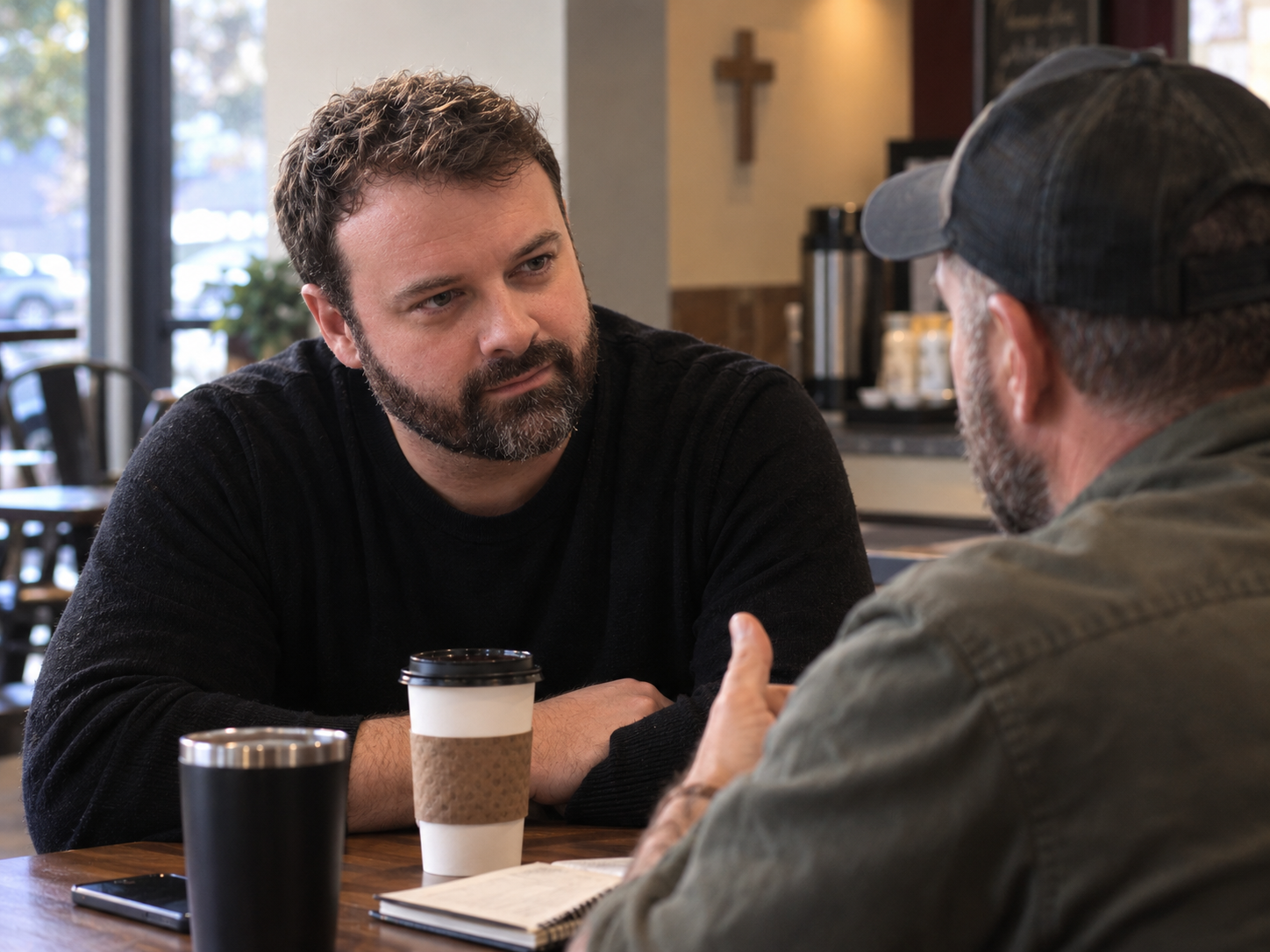
Supervised teen drinking can reduce one night’s danger while teaching that conviction bends when pressure enters the room.
The short version
Parents allowing teen drinking may lower the chance of an impaired drive while giving adult approval to conduct that weakens judgment.
Every permission teaches a young person how authority handles pressure and whether convictions survive inconvenience.
Firm boundaries should stand beside a reliable rescue promise that one call will bring a safe ride home.
After a bad decision, secure safety first, then connect consequences to deception, damaged trust, and abused freedom.
A man’s own restraint gives credibility to the standard he asks a younger person to carry.
The car keys sit in a desk drawer. A parent stands near the basement stairs. Behind the closed door, teenagers laugh too loudly, plastic cups in hand, while the adult tells himself the house is safer than some stranger’s place across town.
He knows what can happen at a party. Bad decisions. Reckless driving. A frightened teenager calling someone who never answers. He has decided that supervision gives him a measure of control.
From ten feet away, it looks almost responsible.
That is what makes the argument dangerous.
The Parent With the Keys
Start with the strongest version of the lenient parent’s position. Give him the courtesy of assuming he loves his child, because he probably does.
He sees drinking and partying as facts he cannot erase. Teenagers take risks. Some lie. Some follow the loudest person in the room. Some make choices with the judgment of a board member who skipped the financial statements and approved the acquisition anyway.
The parent figures proximity gives him leverage. He controls the house. He can collect the car keys. He can hear when the volume changes. He can step through the basement door if someone becomes sick, frightened, aggressive, or unable to stand.
He would rather face an uncomfortable scene under his own roof than receive a panicked call from an unknown address.
That reasoning deserves respect. Fear for a child can press hard against a man’s ribs. A father knows how quickly an ordinary night can turn. One careless decision can bring flashing lights into a driveway. A single phone call can divide a family’s history into before and after.
So he chooses control.
He tells the teenagers they can drink as long as they stay inside. He may establish limits. He may watch closely. He may believe that strict prohibition would drive the behavior underground, where every risk becomes harder to see.
This is the language of harm reduction. It comes with rules, locked doors, surrendered keys, and the steady confidence of a man who has built himself a small compliance department near the stairs.
The parent also wants his teenager to call him when trouble comes. He fears that a hard boundary will produce secrecy. He has heard enough stories about young people hiding mistakes from severe parents. He wants trust. He wants communication. He wants to remain the safe person in the room.
Those desires carry genuine tenderness. A father who waits near the door because he wants every teenager alive at the end of the night has something decent in him. Love has made him alert. Fear has made him practical.
And practical men can talk themselves into nearly anything once the car keys are secured.
The Unknown House Across Town
The alternative scares parents for good reason. An unsupervised party strips away the few controls an adult can provide.
The house belongs to somebody else. The parents may be absent. The teenager may depend on another teenager for transportation. No trusted adult stands nearby. Nobody knows what is in the cups, who brought it, or how much anyone has consumed.
A lenient parent looks at that possibility and reaches a blunt conclusion: if the behavior will happen anyway, move it somewhere visible.
There is an appealing honesty in that sentence. Teenagers possess agency. Parents possess limits. A father can establish a curfew, inspect the car, ask direct questions, and still discover that another human being has a will of his own.
Parenting exposes a humiliating fact about leadership. Authority gives you responsibility far beyond the control it gives you.
Every CEO learns a lesser version of this. You can publish the policy, hold the meeting, revise the org chart, and watch an employee do the one thing discussed in bold type on page one. Add adolescence, social pressure, developing judgment, and a closed basement door, and the illusion of control begins shedding parts in the driveway.
I have written policies that seemed brilliant while they lived on my screen. Then actual human beings encountered them, and the policy developed the structural integrity of a folding chair at a board meeting. So I understand why a father values the control he can get.
Parents who allow teen drinking under supervision often frame their decision around this comparison. Their house has an adult. Their house has rules. Their house has transportation under control. Their house allows intervention.
Compared with an unknown party, that house can appear safer.
The argument also promises an open relationship. The teenager sees the parent as reasonable. The parent avoids becoming the enemy. Future conversations remain possible. A mistake becomes something the teenager can disclose without expecting immediate exile to a monastery.
There is wisdom in keeping communication open. Shame can drive people into hiding. Panic makes poor counsel. A teenager who has made a bad decision needs an adult capable of responding without turning the living room into a courtroom drama performed by one actor.
Compassion matters. Composure matters. A father who can receive a frightened call and move toward his child has done something valuable long before he says a word.
The lenient position rests on love, realism, and fear. That combination can sound unbeatable.
Then the basement door opens, and the question changes.
The Question Safety Cannot Answer
Safety asks how to reduce immediate harm. Conscience asks whether the conduct belongs in the life being built.
Those questions can sit in the same room. They can never replace each other.
A father who offers supervised permission has made a moral decision before the first cup reaches a teenager’s hand. He has taught that a questionable act becomes acceptable when enough controls surround it.
Safety can protect a body for one night. It cannot tell a soul what kind of man to become.
This is the failure inside the lenient argument. It treats the parent’s duty as risk management. The father becomes the compliance officer. He takes the keys, monitors the volume, watches the stairs, and calls the arrangement responsible because the worst outcome failed to occur.
The family liability department has spoken. Apparently, it operates beside the basement door.
Leadership reaches further than preventing catastrophe. A father forms judgment. He names what deserves pursuit, what deserves restraint, and what kind of freedom a young person is preparing to carry.
Every boundary teaches. Every permission teaches. Silence teaches with remarkable efficiency.
When an adult permits conduct he believes is wrong, the teenager learns a lesson larger than drinking. He learns that convictions bend under social pressure. He learns that moral language belongs in public statements while practical decisions happen in a separate room.
That division follows a young man into college, work, relationships, money, and leadership.
He can become the employee who signs the ethics policy and manipulates the numbers. He can become the executive who speaks about people while treating employees as entries on a budget sheet. He can become the man who says family comes first and gives every useful hour to strangers in a conference room.
He has already learned the operating system: say the approved thing, manage exposure, and continue.
Supervised sin still trains a young person to separate risk management from righteousness.
The word sin makes polished people shift in their chairs. It sounds severe. It refuses to wear the pleasant gray suit we prefer for complicated conversations.
Yet sin names a reality that safety language cannot reach. Some actions deform judgment even when an adult controls the room. Some permissions weaken authority even when nobody drives. Some nights end without an ambulance and still leave damage behind.
Safety measures outcomes. Conscience measures allegiance.
A father must care about both.
Permission Writes the Policy
A teenager studies what adults permit far more closely than what adults announce.
He notices the distance between the family speech and the family practice. He sees whether rules survive inconvenience. He observes which convictions disappear when social acceptance enters the room.
A teenager can audit adult inconsistency with the precision of a board member finding an unexplained expense. He may forget his assignment, his curfew, and the jacket he left in the car. He will remember every exception you created for yourself.
Suppose a father says drinking carries risks for a developing young person. Then he provides the location and supervision for it. His words and conduct have entered separate departments.
The teenager receives the conduct.
Permission writes the policy. Speeches become supporting documents nobody opens.
This reaches beyond alcohol. The young person is learning how authority handles pressure. He sees whether a leader tells the truth when truth creates conflict. He watches whether love means approval or whether love can hold a boundary through slammed doors, accusations, silence, and disappointment.
A boundary that collapses under anger was merely a preference wearing a badge.
Fathers often fear losing relational access. That fear has weight. A teenager can withdraw. He can stop talking. He can punish a parent with distance and carefully rationed words.
A man who loves his child feels that distance as a physical ache. He remembers the younger child who reached for his hand without calculation. Then adolescence arrives with a locked bedroom door and a vocabulary apparently purchased from hostile legal counsel.
The father wants connection back. He may trade a boundary for it.
The trade rarely buys what he hoped.
Approval cannot create durable trust because trust depends on truth. A young person needs to know that his father’s words survive pressure. He needs an adult whose love remains present when permission disappears.
That kind of love feels harsher in the moment. It has to stand in the hallway and hear, “You do not understand.” It has to absorb comparison with every supposedly reasonable parent in the county. It has to become unpopular without becoming cruel.
The father should listen carefully. He should ask what his teenager expects to happen at the party. He should ask who will attend, how transportation will work, and what pressures already exist. He should answer questions without theatrics.
Then he should state the boundary plainly.
No speech designed for an arena. No trembling lecture about civilization. No threat involving consequences he lacks the will to enforce. Teenagers can detect inflated rhetoric before the second sentence clears the runway.
A few direct words will do: “I love you. I understand why you want this. I will come get you from any place at any hour. I will not provide permission for this.”
Love remains. Rescue remains. The boundary remains.
Mercy After the Bad Decision
A firm boundary creates another danger. A father can become so invested in being right that he becomes useless when his child fails.
The phone rings. The teenager has been drinking at a party. He sounds frightened. The father now has two responsibilities: get him home safely and deal honestly with the choice.
The order matters.
Rescue first. Conversation after the immediate danger has passed. Consequences when everyone can speak without panic controlling the room.
A father who uses the frightened call as an opportunity for humiliation teaches the teenager to hide the next crisis. A father who erases every consequence teaches him that distress cancels responsibility.
Grace holds truth and mercy in the same hand.
The teenager needs to hear several distinct things. The call was the right decision. The drinking was the wrong decision. The father’s love remains. The loss of freedom or trust follows the conduct. Restoration will require action rather than dramatic promises delivered under fluorescent lights.
That conversation will feel untidy because people are untidy. A teenager can be relieved, ashamed, defensive, and angry within the same minute. An adult can be grateful for safety and furious about deception. Nobody needs to pretend those emotions arrived in matching folders.
This is where fatherhood moves beyond rule enforcement. The aim is formation. The young person must connect actions to consequences, truth to freedom, and repentance to repair.
Ask direct questions after the crisis settles:
- What did you expect would happen?
- When did you know the decision had gone wrong?
- Who else carried risk because of your choice?
- What truth did you hide before leaving?
- What responsibility belongs to you now?
Those questions force ownership. They also keep the father from delivering a forty minute monologue that begins with alcohol and somehow ends with national decline, the family name, and a disappointed ancestor.
I have produced lectures with more departments than an org chart. Volume increased. Wisdom did not.
The better conversation stays close to the conduct. If trust was broken, name the lie. If transportation became dangerous, name that risk. If another person was pressured or harmed, center that person rather than the teenager’s embarrassment.
Consequences should connect to the choice. Reduced freedom follows abused freedom. Increased supervision follows deception. Restitution follows damage. Empty punishment invites a contest of wills, and teenagers have enough spare energy to turn that contest into a full fiscal year.
Mercy never requires pretending the decision was harmless. It gives the young person a road back.
A father can stand firm before the party and remain tender after the failure. Those qualities belong together. Strength without tenderness becomes domination. Tenderness without strength becomes permission.
The Man at the Basement Door
The parent near the stairs wants to keep everyone safe. That desire remains honorable. The method carries a price he cannot record on a household balance sheet.
By hosting or permitting the drinking, he assumes a role beyond rescuer. He becomes a participant in the permission structure. His presence tells every teenager in the basement that an adult has approved the arrangement.
He also carries responsibility toward the other parents whose children entered the house. Their standards, expectations, and knowledge remain outside his control. Supervision does not grant him moral authority over another family’s boundary.
The lenient approach often calls itself realistic. Yet realism includes the social power of an adult’s approval. A teenager sees the house, the parent, the surrendered keys, and the absence of intervention. He understands the message.
Adults approved this.
The father may answer that prohibition drives behavior elsewhere. Sometimes it will. A boundary cannot guarantee obedience.
A company policy cannot guarantee honesty. A contract cannot guarantee performance. A locked cabinet cannot guarantee restraint. We still establish standards because leadership includes naming what belongs inside the organization, the home, and the life entrusted to us.
A father’s authority loses its center when avoiding rebellion becomes his highest goal.
The practical response begins before any party. Talk about alcohol before the invitation arrives. Discuss why people use it, why social pressure works, how judgment gets compromised, and what your family expects. Keep the conversation free of fantasy. Teenagers already know adults sometimes drink, sometimes lie about drinking, and sometimes preach standards they ignore.
If alcohol exists in the home, the adult’s conduct belongs in the conversation. A father who demands restraint while displaying none has supplied the teenager’s entire rebuttal. The young person has eyes. He also has the cross examination skills of an ambitious courtroom attorney.
State the emergency promise clearly: “Call me. I will come get you. Your safety comes first in that moment. We will deal with the decision afterward.”
That promise must survive inconvenience. It applies when the hour is late, the drive is long, and the father is angry. If the teenager believes the rescue will include public humiliation during the ride, he will search for another option.
Set consequences before the crisis when possible. Tell the teenager what happens if he drinks, lies about his location, rides with an impaired driver, or hosts prohibited conduct. Specific consequences remove some of the emotional improvisation that makes families say wild things under pressure.
Coordinate with other parents when a gathering is involved. Ask who will be present and what will be permitted. Vague assurances deserve follow-up. “We will be around” can mean an adult is in the building, on the property, or theoretically reachable through several layers of voicemail.
Teach an exit plan. A teenager should know how to leave without depending on social courage he may lack in the moment. Give him a phrase, a call, or a message that activates transportation. He can preserve his dignity with peers while the father handles the rest privately.
These actions reduce risk without converting the family home into an approved drinking venue. They also form judgment. The teenager learns that safety and righteousness cooperate. One protects him during failure. The other prepares him to choose before failure arrives.
That distinction matters because adolescence ends. The father will eventually lose the desk drawer, the basement stairs, and the ability to collect the keys.
The young man will enter rooms where nobody loves him enough to intervene. He will face contracts, credit limits, private messages, expense accounts, and closed doors. He will hold freedoms larger than his judgment unless someone helped him build that judgment early.
Rules expire when authority disappears. Conscience travels.
The laughter behind the basement door rises again. The father rests one hand on the knob. The keys remain in the drawer, exactly where he placed them, while the harder question waits on the other side.
What to do about it
Write down the boundary before an invitation or crisis arrives. Include drinking, lying about location, riding with an impaired driver, hosting alcohol, the consequence for each choice, and the route back to restored trust.
Tell any teenager in your care that one call activates a ride home from any place at any hour. Promise safety during pickup, then hold the honest conversation after immediate danger has passed.
Call the parent hosting the next gathering and ask who will be present, what will be permitted, and how transportation will work. Audit your own use of alcohol in the same week, because visible restraint gives weight to your words.
Put the rescue keys where you can reach them, then refuse to stand guard over conduct you have approved.
Faith. Finance. Focus.
Strong Men. Strong Homes. Strong Businesses.
Discover More: mrwhatley.com
All My Links: mrwhatley.com/connect
Ready to Be a Better Man? mrwhatley.com/check-in
Free Course: mrwhatley.com/free
disciplinefamilyfatherhoodfocusformationhard conversationsleadershipresponsibility