
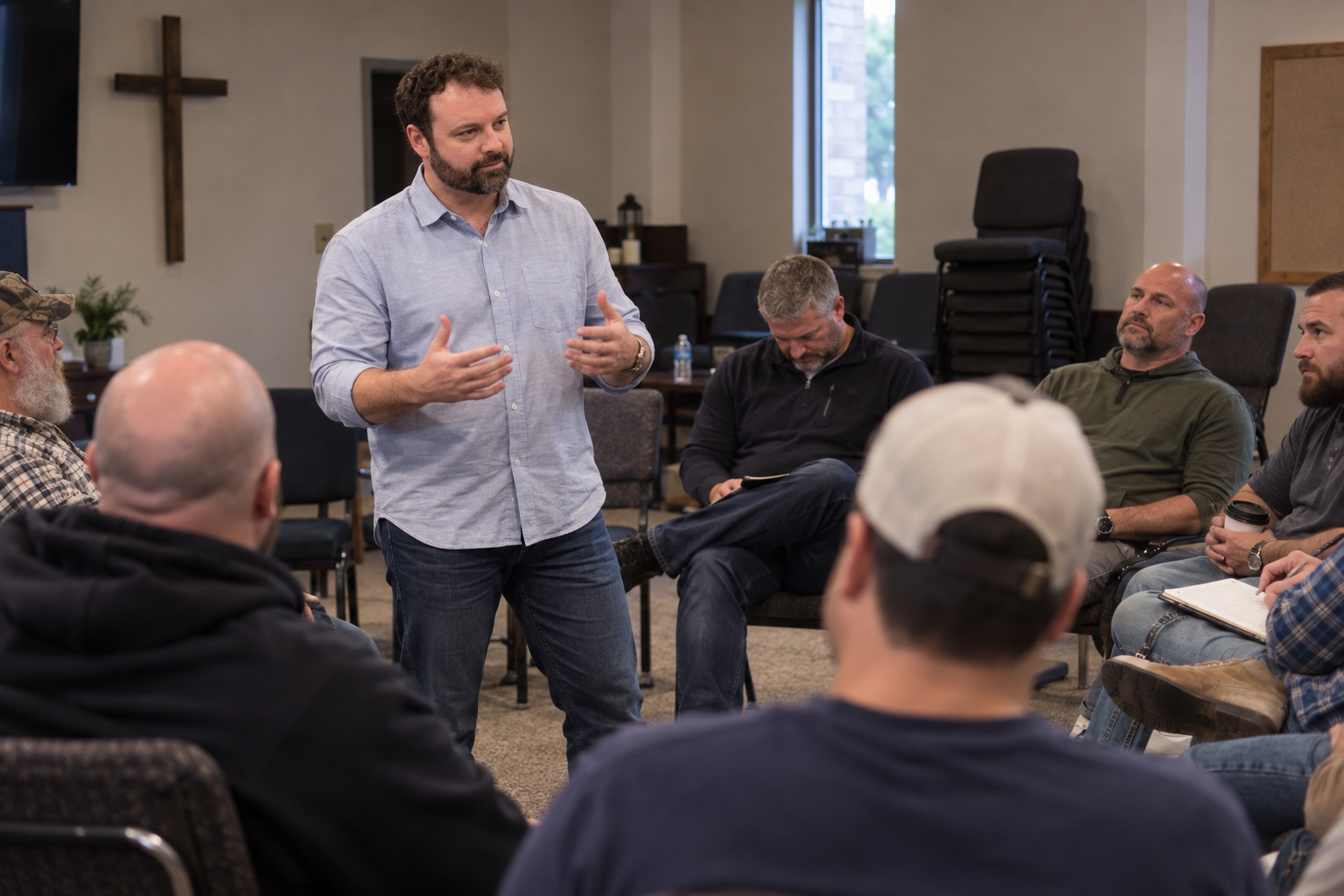
A man learns how to face evil by recognizing hatred early and moving toward the vulnerable before violence arrives.
The short version
Evil rarely announces itself with theater first. It usually starts as contempt, fixation, and talk that trains the conscience to stop seeing neighbors as human.
If you want to know how to face evil, start earlier than the crisis. Learn to recognize dehumanizing speech, dark obsession, and the kind of grievance that keeps circling a target.
Courage is tested long before any violent moment. It shows up when you interrupt the wrong conversation, ask the direct question, and refuse to leave vulnerable people exposed.
The fluorescent lights in a county courtroom make everybody look half-dead. A young man sits there in borrowed seriousness, and somewhere outside that room families are pulling into a temple parking lot with pressed clothes, tired eyes, and the ordinary hope of an ordinary Sunday.
That is the wreck. A 19-year-old man, Alexandros Paporakis of Palatine, Illinois, was arrested on felony charges of making a terrorist threat and unlawfully possessing weapons. Police and prosecutors say he allegedly shared a manifesto outlining plans for mass murder, and authorities believe he was planning an attack on a Hindu temple in Aurora, Illinois, on Sunday, though the specific location remains under investigation.
Before anybody starts polishing this into one more item in the American conveyor belt of dread, slow down and look at the room. A temple. Families. A teenager. Weapons. A manifesto. A plan for Sunday. That is not random static. That is a moral event.
And a lot of men still talk about evil like it is a villain in a bad streaming series. Fog machine. Ominous music. Crazy eyes. Then one day the thing shows up in street clothes, with a payroll stub and a phone in his pocket, and everybody acts stunned that hatred knows how to drive to work.
I have been wrong about this in my own life in smaller ways. I used to think courage arrived on schedule, like some executive stepping into the quarterly review with a sharpened pencil and a clean tie. Turns out courage usually finds you while you are underprepared, slightly confused, and hoping somebody else in the room has a spine. Half the time I am still looking around for the adult, which is a rough discovery when you realize you are the one with gray in your beard.
The blood was not there. The evil was.
The easiest trick in the world is to tell yourself that catastrophe starts at the loud moment. The shattering glass. The screaming. The running. The police tape snapping in the wind. That is when cameras show up, officials clear their throats, and men who cannot balance their own checking accounts suddenly become philosophers of violence.
But the real beginning sits much earlier, in quieter places. In words. In fantasies. In the slow training of the conscience to stop seeing human beings as neighbors and start seeing them as symbols, obstacles, enemies, or a category to be erased.
Here, police and prosecutors say a 19-year-old allegedly shared a manifesto outlining plans for mass murder. Authorities believe he was planning an attack on a Hindu temple on Sunday. Read that again and strip away the legal phrasing for one second. A young man allegedly moved from grievance to imagination to intention. He allegedly drew a line from hatred in the mind to violence in a room full of people.
That line matters. A man who wants to understand the world he actually lives in has to learn to see evil before blood is on the floor. By then, your analysis has arrived embarrassingly late, like a vice president who joins the board meeting after the company already missed payroll.
The temple itself matters too. The target was not just a building in Aurora. It was a place where people gather in reverence, where parents stand beside children, where older men and women move a little slower, where shoes line up by a wall, where voices lower, where a community remembers who it is. Somebody looked at that and, according to the charges, saw a stage for mass murder.
That is hatred with a theology attached to it, even when the person carrying it could not spell theology on a decent day. He has already decided which lives count, which neighbors deserve safety, and which sacred spaces can be turned into killing grounds.
Sunday is when the test comes due
I keep coming back to the detail that authorities believe the attack was planned for Sunday. Of course it was. Sunday is rhythm. Sunday is routine. Sunday is when people stop looking over their shoulder for a minute and turn their attention upward.
Evil loves routine because routine trusts. Evil loves sanctuaries because people come unarmored in spirit, even when there is a security plan in a binder somewhere. The binder has its place. The binder also cannot save a culture that has forgotten what vigilance looks like in the soul.
A lot of men hear a story like this and drift straight to tactics. Carry permits. security teams. cameras. exits. Those questions matter. If you are responsible for any gathering of people, from a church to a company event to a local meeting, pretending danger only exists in other zip codes is a foolish man’s hobby.
But tactics come after recognition. If a man cannot recognize the shape of hatred when it starts talking, posting, fantasizing, or circling a target, then all his brave talk is decorative. It is the kind of chest-thumping that folds like a cheap lawn chair when reality enters the room.
There is a reason this kind of thing rattles any serious Christian man, even when the target is a Hindu temple and not a church pew. Neighbor is not a tribal word. A neighbor is the person in front of you, the person down the street, the family gathering in a sacred place you do not share but are still bound to respect. If your theology only produces courage for people who look like you, vote like you, worship like you, and fit neatly in your little private org chart of approved humans, then your theology is sick.
A man’s courage is exposed long before he ever has to tackle a gunman. It is exposed when he hears dehumanizing talk and refuses to laugh along. It is exposed when he sees obsession turning dark and says something direct. It is exposed when he learns that vulnerable people are being singled out and decides their safety is his concern too.
That is where the test comes due. Sunday just reveals whether anybody studied.
The manifesto always starts as talk
Every age has its paper trail. Ours has screens, group chats, files, aliases, private messages, and the digital sewer where people marinate in grievance until their souls look like wet insulation. The details here are spare. What we know is enough. Police and prosecutors say he allegedly shared a manifesto outlining plans for mass murder.
People hear manifesto and imagine a criminal mastermind with a bunker and a string board on the wall. Sometimes evil is less impressive than that. Sometimes it is a bored young man with a bad ideology, access to weapons, and a brain inflated by his own private theater. Sin has always been ridiculous in that way. It promises grandeur and produces ugliness, nonsense, and funerals.
I do not know what was in that manifesto beyond the allegation that it outlined plans for mass murder. I know enough from the history of these things to suspect it carried the usual costume jewelry of grand grievance and counterfeit purpose. Hateful men love to dress cowardice up as destiny. They want to feel chosen while they stalk the defenseless. That trick is older than electricity.
And yes, there is a comic side to the delusion, right up until there is not. The same species that invented the board deck and the leaf blower also keeps producing young men who think scribbling murder plans makes them profound. It does not. It makes them dangerous and pathetic at the same time, which is a brutal combination. A fool with ambition can ruin a lot of lives before breakfast.
Still, laughter has to know where to stop. Because behind every plot like this are real people who did nothing except gather in peace. Men showing up with their families. Older couples moving carefully through the lot. Young people distracted in the ordinary way young people are distracted. Volunteers straightening chairs. Someone checking the clock. Somebody else trying to keep a child close. That room was full of image-bearers before an accused attacker ever projected his grievance onto it.
Hatred always tries to erase the face of the neighbor first. If it can turn a people into an abstraction, then it can pretend murder is a statement instead of what it is. A theft. A rebellion against God. A desecration of the weak and the ordinary.
Everybody wants the movie scene
Men like heroic moments because they come with clean angles. There is the threat. There is the stand. There is the clear action. Your pulse goes up. Your hands know what to do. Nobody has to sort through ambiguity because the room has already sorted it for you.
Real life is meaner. It asks harder things earlier.
It asks whether you can spot fixation before it becomes attack. Whether a young man’s words ring alarm bells in your head. Whether your instinct to mind your own business has turned into cowardice with a respectable haircut. Whether you have trained yourself to stand between the violent and the vulnerable in a thousand unglamorous ways before the crisis.
Most men do not fail at courage in the violent moment. They fail in the soft moments that train the violent one.
They fail when they reward cruelty because it sounds strong. They fail when they baptize contempt as honesty. They fail when they see a man spiraling into hate and decide somebody else will deal with it. They fail when they hear a threat against a religious minority and shrug because it is not their people. They fail when they think evil should always arrive wearing horns instead of khakis.
I know the human instinct here. We want a clean villain from central casting. We want eyes blazing red, thunder in the background, and maybe a soundtrack to help the dumber among us keep up. Instead we get a 19-year-old cashier from Palatine facing felony charges. Evil has always been vulgar that way. It refuses to respect our dramatic preferences.
That is one answer to the ugly question of how to face evil. You start by refusing to demand theatrical packaging before you acknowledge what is standing in front of you. If a man is allegedly planning mass murder, then your categories had better get serious in a hurry.
The neighbor in front of you
I am a Christian. That means I do not get to reserve concern only for the people inside my own walls. If a Hindu temple near Chicago is allegedly being targeted for mass murder, then a Christian man with any moral clarity at all understands this instantly. Those families are my neighbors. Their children are my neighbors. The old man taking slow steps toward the building is my neighbor. The volunteer by the entrance is my neighbor. The young father trying to keep a little one from wandering into the parking lot is my neighbor.
You do not need shared doctrine to recognize shared dignity.
And this is where some men get weird in a hurry. They can speak bravely about defending the innocent in broad terms, but once the innocent belong to a group outside their own tribe, they start acting like lawyers for indifference. Suddenly there is throat-clearing. Suddenly they need context for the very idea that human beings should be able to worship without being hunted. Suddenly the man who was built like a linebacker online turns into a folding chair in real life.
That kind of selective courage is worthless.
There is also tenderness required here, the kind our culture mistrusts because tenderness sounds weak to men who have confused hardness with strength. I think about the families who would have walked into that temple on Sunday carrying ordinary burdens. Bills. strained conversations. job pressure. private grief. hopes for the future they have not spoken out loud yet. They were owed peace in that place. They were owed one quiet hour under a roof set apart for reverence. The fact that someone allegedly aimed hatred at that room is an assault on more than bodies. It is an assault on trust, memory, and belonging.
That is why the decent man never sneers at the vulnerable for being vulnerable. He honors the ordinary innocence of people showing up to pray, to gather, to mark a day as sacred. There is strength in that rhythm. There is beauty in it. The world gets more brittle every time men forget that sacred spaces deserve defenders.
The paperwork before the sirens
The charges here matter because charges draw boundaries. Paporakis faces felony charges of making a terrorist threat and unlawfully possessing weapons. Accused is accused. Charged is charged. That precision matters in a country that is supposed to care about actual process instead of mob theater.
But process can also lull us into passivity if we let it. We hand the whole problem to the state, then sit back like spectators in a bad municipal presentation. The police made an arrest. Prosecutors filed charges. Good. That is part of their job. They should do it well. They should do it without spin, without ideological theater, and without using tragedy as a grant application.
Still, no government agency can manufacture a courageous citizenry. A courthouse can process a defendant. It cannot build men who recognize evil early. It cannot teach a neighborhood to reject hatred before it hardens. It cannot make fathers, mentors, pastors, managers, friends, or bystanders develop moral reflexes.
And there is the grim joke of modern life. We have institutions for everything. Committees. task forces. trainings. advisory councils. PowerPoint decks with arrows pointing nowhere. The republic is drowning in lanyards. Yet the central requirement remains ancient and stubbornly personal. A man has to know that some things must be confronted fast, clearly, and at cost to himself.
I say that as a man who has sat in enough conference rooms to know how quickly responsibility can get turned into a passing game. Everybody nods. Everybody agrees the issue is serious. Then the sentence appears. “We need to make sure someone is looking into this.” That sentence has buried more responsibility than a cemetery. It is the official language of men hoping accountability dies in transit.
When hatred points itself at a vulnerable group, somebody has to own the burden of saying, “No. Here. This matters now.” Sometimes that somebody is a law enforcement officer. Sometimes it is a family member. Sometimes it is a friend. Sometimes it is a leader in a congregation. Sometimes it is a man at work who hears the wrong thing and decides this conversation is taking a different turn.
Young, angry, and handed a lie
Work backward from the arrest and you are forced into the harder territory. A 19-year-old does not arrive at alleged plans for mass murder in a sacred space by tripping over his own shoelaces. There are decisions behind this. Inputs. permissions. fantasies entertained and fed. Maybe there were warnings. Maybe there were signs others half-saw and half-dismissed. Maybe there was isolation. Maybe there was ideology. Maybe there was the intoxicating lie that violence could turn a small, angry life into a significant one.
I do not know all the steps in his chronology, and neither do you. That is fine. The larger pattern is grimly familiar anyway. A young man somewhere gets catechized by contempt. He absorbs a story that tells him other people are defiling the nation, or replacing him, or threatening some imagined purity. He becomes convinced that his private fury is moral seriousness. Then one day his mind stops blinking at bloodshed.
Hatred flatters weak men by telling them they are guardians.
That line should be printed and taped to a thousand bathroom mirrors.
Because the lie works precisely by dressing vice as virtue. Cowardice becomes “conviction.” Isolation becomes “clarity.” Dehumanization becomes “defense.” Murder becomes “purpose.” The human heart can counterfeit almost anything if pride is running the books.
And our culture is excellent at producing men with pain but no formation. We hand them bandwidth, grievance, debt, hormones, a fragmented family economy, and a digital megaphone, then act puzzled when some of them become spiritually feral. I am not excusing a thing. I am naming the air. There is a reason young men can swing from apathy to fanaticism with frightening speed. Empty souls are light enough to be carried by any strong wind.
That is why masculinity cannot just be energy. It has to be governed. Directed. Taught to honor life. Taught to protect. Taught to tell the truth about mortality. A man is going to serve something. God, ego, tribe, lust, bitterness, mission, money, status, resentment. Everybody kneels somewhere, even if he calls it independence.
Left untended, the heart will build a shrine out of whatever flatters it most. Sometimes that shrine ends with a manifesto.
Stand in the doorway
So what does a man do with a story like this besides shake his head and mutter about the times? He gets practical in the places where practical actually means something.
If you are responsible for people gathering, for worship, for a workplace event, for a public meeting, for any room where families or ordinary neighbors show up trusting the basic peace of the place, then security is not paranoia. It is stewardship. Review entrances. Know who is watching them. Make sure communication works. Decide in advance who acts if a threat appears. “We thought somebody else had that” is the sentence of a failed organization and a failed man.
If you are close to young men, watch their words. Not every angry sentence is a plot. Young men say wild things. I said plenty of foolish things when my brain had more horsepower than discipline. But when fixation, hatred, fantasies of violence, or contempt for whole groups starts showing up, do not grin and write it off as edge. Press in. Ask direct questions. Pull other adults in when needed. Refuse the lazy religion of minding your own business while someone drifts toward darkness.
If you hear dehumanizing speech aimed at a religious minority, confront it plainly. No lecture circuit voice. No management memo. Plain words. “That is evil.” “You do not talk about people that way.” “You do not threaten families in a place of worship.” That kind of moral clarity feels old-fashioned now, which is a disturbing commentary on us, not on moral clarity.
If you are a man trying to build your own life into something sturdy, train your reflexes before a crisis. Practice noticing who is vulnerable in a room. Practice moving toward tension instead of away from it. Practice saying the true thing aloud when falsehood would be easier. Courage under pressure usually cashes checks written in private.
There is your second answer to how to face evil. Learn to stand in the doorway before anybody asks you to be a hero. The doorway might be a conversation. It might be a policy. It might be a parking lot. It might be your own stubborn refusal to let hatred borrow your silence.
The room still matters
By the time chronology arrives, the moral picture is already plain. A 19-year-old from Palatine was arrested. He faces felony charges of making a terrorist threat and unlawfully possessing weapons. Police and prosecutors say he allegedly shared a manifesto outlining plans for mass murder. Authorities believe he was planning an attack on a Hindu temple in Aurora on Sunday, though the specific location remains under investigation.
Those are the known points on the page. There will be more process, more statements, more parsing, more people trying to fit this into their preferred ideological filing cabinet. Some will use it to flatter their politics. Some will use it to harden their tribe. Some will make themselves the center of a danger aimed at somebody else. Human vanity wastes no time.
I keep seeing the room instead.
The parking lot. The entrance. The low hum before a service begins. A child tugging at a sleeve. A man straightening his posture before stepping inside. An older woman moving carefully over the pavement. A family carrying invisible burdens and hoping for one sacred hour of stillness. The attack authorities believe was being planned would have torn through all of that. It would have taken names, futures, and the fragile trust people carry into holy places.
A decent society asks men to notice that before the sirens. A faithful man asks more of himself. He learns to recognize hatred early, to name it cleanly, and to stand between the violent and the vulnerable while there is still time for ordinary people to keep walking toward the door.
That is where my mind lands tonight. Not on the accused man’s fantasy of significance. Not on the bureaucratic script that follows. On the doorway of a temple in Aurora, still standing in my imagination, with families arriving under a gray Midwestern sky, unaware of how close some stranger’s darkness may have drifted to the threshold.
What to do about it
This week, think of one room you care about where people gather in trust. It may be a church, a class, a meeting, or a family routine. Walk through the entrance, the parking lot, and the communication plan with fresh eyes.
If there is a young man in your orbit whose words have turned dark, do not stay vague. Ask him direct questions about what he is feeding his mind, what groups he talks about with contempt, and whether his anger is becoming fantasy.
If someone around you speaks about a group of people as less than human, answer it in the moment. Use plain words that leave no fog in the room and no borrowed safety for hatred.
Picture the doorway before Sunday starts, and decide you will be the man who notices what is coming toward it.
Faith. Finance. Focus.
Strong Men. Strong Homes. Strong Businesses.
Discover More: mrwhatley.com
All My Links: mrwhatley.com/connect
Ready to Be a Better Man? mrwhatley.com/check-in
Free Course: mrwhatley.com/free