
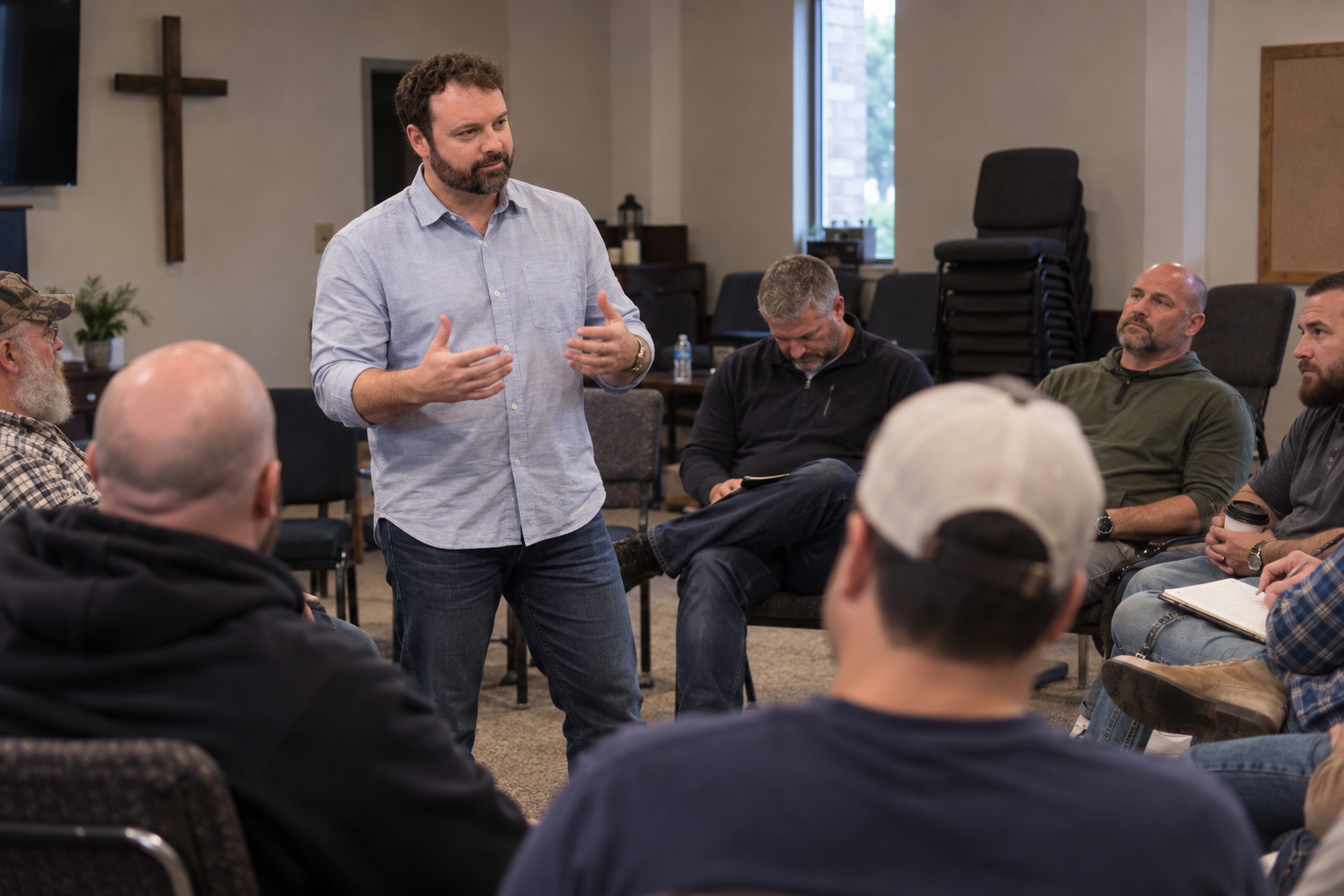
Dependable men pair moral clarity with attentive care when postpartum suffering reaches a home, friendship, church, or workplace.
The short version
Postpartum suffering requires attention before opinion, especially when thoughts of self-harm, harm to a child, hallucinations, or detachment from reality appear.
A dependable man listens, helps secure qualified care, and stays engaged after the appointment is made.
Learning how to support your wife begins during calm weeks, with names, phone numbers, warning signs, and a plan for immediate danger.
Every man can become useful when a relative, friend, church member, employee, or neighbor discloses a crisis.
The phone in his hand shows a courthouse in Plymouth, Massachusetts, and a crowd wearing pink. He sees the name Lindsay Clancy, reads three furious comments, and moves his thumb before the faces of Cora, Dawson, and Callan ever reach him.
Cora was 5. Dawson was 3. Callan was 8 months old. Their mother is accused of strangling them in January 2023 before attempting suicide, and her criminal responsibility has yet to be legally decided.
The man holding the phone has convictions about marriage, children, fathers, mothers, and the order God built into family life. He believes those convictions are sturdy. They have survived elections, workplace seminars, cultural ridicule, and several hundred internet strangers with profile pictures taken inside pickup trucks.
By the end of this ordinary day, those convictions will be tested four times.
He will never notice the test.
His Thumb Reaches the Verdict First
The man scrolls past the Plymouth Superior Court before work. He learns just enough to become certain, which is the preferred education model of social media.
For more than a month during the summer of 2026, the proceedings held national attention. Clancy was charged with killing her three children. Her defense argued that severe mental illness had developed into psychosis and that hallucinations preceded the deaths. A psychologist testified that Clancy said she heard a male voice ordering her to kill her children and herself.
Clancy had taken several psychiatric medications before January 2023. Her husband and family knew she was struggling with her mental health. Those facts establish suffering. They do not settle criminal responsibility. A courtroom must handle that question through evidence, law, testimony, and judgment.
The internet prefers a faster system. It places twelve angry avatars in the jury box and appoints the algorithm as judge. Due process lasts until the next notification.
Outside the courthouse, the argument split into two loud camps. Hundreds of women rallied in pink to support Clancy. Some posts used the phrases “Same, Lindsay” and “Me too, Lindsay.” Other voices treated postpartum depression and postpartum psychosis as convenient language for selfishness or criminal excuse making.
The man with the phone dislikes both camps. He considers himself balanced because he rolls his eyes at everyone equally. I have employed this method myself. It produces the warm sensation of wisdom while requiring roughly the intellectual effort of selecting a tie.
He decides that mothers should love their children, fathers should lead, and people should take responsibility for their actions. Every sentence is true. Together, they remain incomplete.
Truth becomes cheap when a man uses it to avoid the suffering standing directly in front of him.
The children remain distinct from every cultural argument built around their deaths. Cora, Dawson, and Callan were victims. Their names deserve more room than the slogans, the pink clothing, the posts, and the political point scoring.
Compassion for mental illness cannot erase those children. Moral judgment cannot erase the reality of postpartum suffering. A man capable of holding only one of those truths has confused conviction with limited attention.
He slides the phone into his pocket. First contact. No mark on him that he can see.
The Conference Room Has Thin Walls
Later that morning, a woman on his team asks for ten minutes. She closes the conference room door, sits across from him, and says her sister recently gave birth. The sister has become frightened by her own thoughts. The family has started making calls and arranging help.
This woman is asking to adjust her schedule for a few days. She is trying to speak calmly. Her hands keep folding and unfolding around a legal pad.
Our composite man hears “schedule” and reaches mentally for policy. Leaders love policy because policy sits still. Human beings insist on breathing, crying, changing, and calling at inconvenient hours.
He approves the request. He uses a kind voice. He tells her family comes first, a phrase printed on enough corporate walls to qualify as load bearing.
Then he turns toward the next meeting.
He never asks whether the family has immediate support in place. He never tells her that she can contact him if the situation becomes urgent. He never checks whether another employee can cover the work without quietly resenting her. He grants permission and considers the matter handled.
This is the second time the case touches his day. He still does not see it.
Postpartum depression and postpartum psychosis carry different levels of severity. The facts surrounding Clancy prompted a national argument precisely because severe mental illness and criminal responsibility can occupy the same courtroom without becoming the same question.
That distinction matters outside court too. A mother can love her child and suffer severe psychiatric symptoms. A family can take those symptoms seriously without declaring every action beyond responsibility. A husband can protect his children, seek qualified help for his wife, and refuse the two cultural scripts offered to him: denial on one side, excuse making on the other.
Men who speak publicly about biblical family order often have plenty to say about authority. Responsibility receives fewer speaking invitations.
Authority without attentive care is vanity wearing a church jacket.
A leader who advocates for family life must build an organization where employees can disclose a family crisis without entering a maze of polished phrases. That has operational costs. Someone covers the work. A deadline moves. A manager makes a call. The P and L statement may register the disruption.
Those costs belong in the conversation. Family friendly rhetoric funded entirely by exhausted employees is corporate theater with better typography.
The same principle applies inside a home. A man asking how he can support his wife after childbirth needs specific duties in front of him. Listen without cross examining her. Learn which symptoms have frightened her. Help contact a qualified medical professional. Take statements about self-harm, harming a child, hallucinations, or losing contact with reality seriously. Bring in trusted family or community support. In an immediate threat to anyone’s safety, contact emergency services.
He should also know his limits. Love does not award a medical license. Confidence has sent many men marching into walls that humility would have noticed.
Our man returns to the conference room later and sees the abandoned legal pad. He places it near the door for the employee to collect. The room is ready for its next meeting, which is the sort of efficiency that photographs beautifully and explains very little.
The Numbers Sit in the Board Deck
At midday, someone presents a slide about workforce trends. Marriage and birth patterns appear as small lines beneath larger business concerns.
The marriage rate fell from 8.3 per 1,000 in 2000 to 6.3 per 1,000 in 2024, the Centers for Disease Control and Prevention says. The fertility rate was 2.12 children per woman in 2007 and 1.6 children per woman in 2024.
Numbers that large arrive in a conference room stripped of texture. They look like demographic weather. Everyone nods as if an analyst has announced humidity.
Yet each number contains decisions made in apartments, church pews, bank lobbies, medical offices, and parked cars. Some people want marriage and have not found a trustworthy spouse. Some fear divorce, debt, betrayal, or the demands of raising children. Some pursue careers. Some face medical limitations. Some simply prefer another life.
Calling all of them selfish saves a great deal of thinking. It also persuades almost nobody.
In 2024, the median age at first marriage was 28.4 for women and 30.8 for men. In 1956, those median ages were 20.1 for women and 22.5 for men. The shift is substantial. A slogan cannot explain it, and a scolding cannot reverse it.
The man in our conference room supports marriage and parenthood. So do I. Marriage asks a man to bind his future to promises made before he knows every cost. Parenthood places a vulnerable life within reach of his character. Both expose selfishness with the efficiency of an audit.
That is part of their goodness. It is also part of their difficulty.
When advocates present family life as a permanent stream of smiling photographs, young adults eventually discover the omitted pages. They find exhaustion, conflict, medical fear, financial pressure, interrupted plans, and days when love feels like duty carried on shaking legs.
The polished sales pitch then collapses. People suspect the institution was oversold when the messenger simply lacked the courage to describe sacrifice.
A man weakens his witness when he praises motherhood in public and dismisses a suffering mother in private.
Biblical order assigns weight. It puts duties on husbands, fathers, mothers, children, churches, and communities. Men love the diagrams because arrows look decisive. The arrows become less popular when they point toward a medical appointment, a changed calendar, a crying woman, an anxious child, or an interrupted quarterly review.
I enjoy a clean diagram myself. Give me an org chart and ten minutes and I can rearrange humanity into boxes with alarming confidence. The boxes always behave. That should have been my first warning.
Family life refuses the chart. People become ill. Children wake repeatedly. A wife who carried a child can experience rapid and severe changes after birth. A husband can become exhausted, confused, and afraid too. None of this cancels responsibility. It tells us where responsibility must operate.
Our man glances at the marriage and fertility figures, then checks the quarterly forecast. Third contact. The slide advances.
Four Words Draw 4.7 Million Eyes
In the afternoon, his phone places another fragment in front of him.
On Aug. 17, 2026, Matt Walsh posted that much of the depression parents experience after childbirth results from the demands of children and the need to subordinate adult desires. He connected a harder adjustment with greater selfishness. The post received 4.7 million impressions.
Four million seven hundred thousand impressions can make a sentence look proven. Billboards achieve impressions too. Nobody asks one to diagnose psychosis.
There is a truth inside the argument. Children demand sacrifice. Adults accustomed to controlling their time experience a severe adjustment when a baby arrives. Self-centeredness makes duty harder. Men should hear that plainly.
The statement still reaches beyond its competence when it explains depression primarily through selfishness. Postpartum mental health struggles include experiences far more serious than disappointment over a changed schedule. In the Clancy proceedings, the defense argued psychosis and hallucinations. A psychologist testified about an alleged command from a male voice. Several psychiatric medications were already involved before the children died.
Those particulars demand disciplined speech.
A public Christian witness carries an added burden here. We claim human beings possess moral agency. We also claim human beings are embodied creatures who suffer, break, grieve, weaken, and depend upon grace. Remove agency and responsibility dissolves. Remove suffering and compassion becomes decorative.
The man scrolling does not need a graduate degree to understand this. He needs enough humility to stop diagnosing strangers through a screen.
He sends the post to a friend with one sentence: “This is what nobody wants to say.”
The friend replies that his own wife struggled badly after one of their children was born. She loved the baby. She also became frightened, detached, and unable to trust her own thoughts. Qualified care helped their family through the crisis.
Our man pauses.
He types, deletes, and finally sends, “I’m sorry. I didn’t know.”
That sentence carries more honor than the one he forwarded. He still fails to connect the exchange to the courthouse, the employee, and the board deck. The reader can see all four points beginning to line up.
The practical question has changed. A married man needs to ask his wife what support looks like before a crisis arrives. A single man can learn how to respond when a sister, friend, employee, or church member discloses postpartum suffering. A widower, divorced man, grandfather, or young man preparing for future responsibility can learn the same distinctions.
No man receives exemption from becoming dependable.
Dependability here has names and actions. Know who the medical professionals are. Keep contact information available. Learn which family members can arrive quickly. Discuss warning signs during calm weeks. Make room for an employee to seek help. Refuse online mockery that labels suffering women as selfish by default. Refuse the opposite error that converts suffering into automatic innocence.
Compassion does not require a man to lie about evil. Truth does not require him to become cruel.
Pink Signs and Three Small Faces
On Aug. 26, 2026, supporters protested during the murder trial in Plymouth, Massachusetts. On Sept. 1, 2026, a woman outside the Plymouth Superior Court Building held a sign with photographs of the three children.
Those two scenes belong beside each other.
One woman at a rally said women are dismissed, neglected, and ignored when they speak up. That complaint deserves an honest hearing. Many women fear that admitting dark thoughts or severe symptoms will bring ridicule, panic, or condemnation. Families sometimes hear the first disclosure and reach for denial because denial feels cheaper than disruption.
Then there are the children.
Cora. Dawson. Callan.
Any movement that centers its own grievance so completely that three dead children fade into the background has lost moral proportion. The same judgment applies to commentators who use the children’s deaths as permission to sneer at every mother describing depression.
The victims should never become stage furniture for somebody else’s ideology.
This is where public witness earns credibility or spends it.
A man can say that the alleged acts were horrifying. He can insist upon legal accountability while acknowledging that criminal responsibility remains for the legal process to decide. He can recognize severe mental illness without turning Cora, Dawson, and Callan into footnotes. He can mourn the children and still hear the warning carried by women who say they fear being dismissed.
That posture requires more strength than choosing a team online. Team selection is easy. A jersey removes the burden of thought.
The proposal for a healthier family culture asks conservatives to speak honestly about motherhood, encourage involved fathers, support families, and remove shame from seeking help. Those ideas carry merit. Their weakness appears when “support” remains a pleasant noun with no owner, cost, calendar, or phone number attached.
Who carries it out?
Husbands do, when present. Extended family does. Churches do. Employers do. Friends do. Medical professionals do. Community institutions do. Each has different authority and limits. None should pretend the others will handle everything.
What does it cost?
Time away from work. Changed schedules. Medical care. Childcare. Sleep. Emotional strain. Privacy. Money. Uncomfortable conversations. A manager rearranges assignments. A church member sits with a frightened family. A husband hands over control to qualified professionals when the situation exceeds his judgment.
Those are tangible costs. They are also the substance hidden inside the word support.
A church that celebrates every pregnancy announcement and disappears during postpartum crisis has built a stage, not a community. A company that praises families while punishing every interruption has written fiction into its employee handbook. A husband who quotes order while refusing inconvenience has reduced leadership to seating position.
Our man sees the photograph of the sign outside the courthouse. The three small faces hold him for several seconds. Then an incoming call covers the screen.
The Pew Does Not Grade on Volume
That evening, he sits in a church pew. The service includes a prayer for families, mothers, fathers, and children.
He agrees with every word.
He knows Ephesians 5 places sacrificial responsibility upon a husband. Christ’s care for the church supplies the measure in Ephesians 5:25. The standard is costly love directed toward another person’s good.
Men have sometimes handled that passage like junior executives discovering an organizational chart. They find the line about authority, circle it twice, and somehow misplace the pages describing sacrifice.
Biblical family order gives a man duties before it gives him talking points. He must speak truth. He must protect the vulnerable. He must carry responsibility. He must treat his wife with honor. He must possess enough humility to recognize suffering that he cannot personally fix.
A man asking how to support his wife during postpartum distress begins with attention. He notices changes. He believes her description of her own mind enough to investigate. He avoids both panic and dismissal. He helps secure qualified care and remains engaged after the appointment has been scheduled.
Support also includes the ordinary load around the crisis. Calendar changes. Calls. Transportation. Care for children. Communication with trusted family. Conversations with an employer. Protection from online spectacle. A crisis requires someone to remember details while everyone else feels the walls moving.
Men without wives still belong inside this charge. Character forms before the role arrives. The way a single man speaks about struggling mothers reveals the kind of husband, friend, leader, or church member he is becoming. The way an executive responds to an employee’s family emergency reveals what his convictions cost when payroll and deadlines enter the room.
Our man remembers the employee with the legal pad.
He considers sending a message. It feels intrusive, so he hesitates. Then he writes a short note asking whether the family has the help it needs and whether someone has covered her responsibilities for the next few days.
She replies that another manager handled the coverage. She thanks him for asking. Her sister is with family and seeking professional care.
He reads the message twice.
Nothing dramatic happens in the pew. No beam of light strikes the carpet. No swelling music announces growth. He simply realizes that approving an absence and caring about the person who requested it are separate acts.
That is a small realization. Small realizations have rescued more relationships than grand declarations ever will.
The Hallway Light Stays On
At home, the day leaves its debris across his mind: Plymouth Superior Court, three children, hundreds of women in pink, a post with 4.7 million impressions, marriage rates from 2000 and 2024, fertility rates from 2007 and 2024, the legal pad in the conference room, the reply from his friend.
He still does not assemble them into a grand theory. Most men do not live inside grand theories. They live inside calendars, mortgage statements, performance reviews, medical calls, text messages, and promises that become expensive at inconvenient times.
He has spent years defending the family as an institution. He has been right to do so. Marriage and parenthood deserve defense in a culture increasingly suspicious of obligation.
Defense requires a fuller vocabulary than celebration.
A credible man can describe motherhood as meaningful while acknowledging exhaustion, anxiety, grief, depression, and severe psychiatric illness. He can encourage children without selling young adults a polished illusion. He can honor maternal sacrifice without treating mothers as machines built to endure silently.
He can also retain moral boundaries. Suffering never turns children into abstractions. Compassion never requires chants of identification with an accused killer. The deaths of Cora, Dawson, and Callan remain the fixed point in this case, three lives that should have continued beyond January 2023.
The man passes a dark hallway and notices one light still on. He reaches for the switch, then stops.
His phone is in his other hand. The message from his friend remains open, the one about the frightening months after childbirth and the help that finally came.
He begins typing a question he should have asked years ago.
The hallway stays lit while he searches for the right words.
What to do about it
Have one calm conversation this week with the person or family you may need to support after childbirth. Ask which changes would feel alarming and who should be contacted first.
Save contact information for a qualified medical professional, trusted family members, and emergency services. Treat statements about self-harm, harming a child, hallucinations, or losing contact with reality as urgent.
If you lead employees, review how your organization handles a family crisis. Decide who can adjust assignments, protect privacy, and follow up after the schedule change is approved.
Before Sunday night, send one quiet message to someone carrying this burden: Do you have the help you need? Keep the hallway light on while you wait for the answer.
Faith. Finance. Focus.
Strong Men. Strong Homes. Strong Businesses.
Discover More: mrwhatley.com
All My Links: mrwhatley.com/connect
Ready to Be a Better Man? mrwhatley.com/check-in
Free Course: mrwhatley.com/free
discipleshipfaithfamilyhard conversationsleadershipresponsibility