
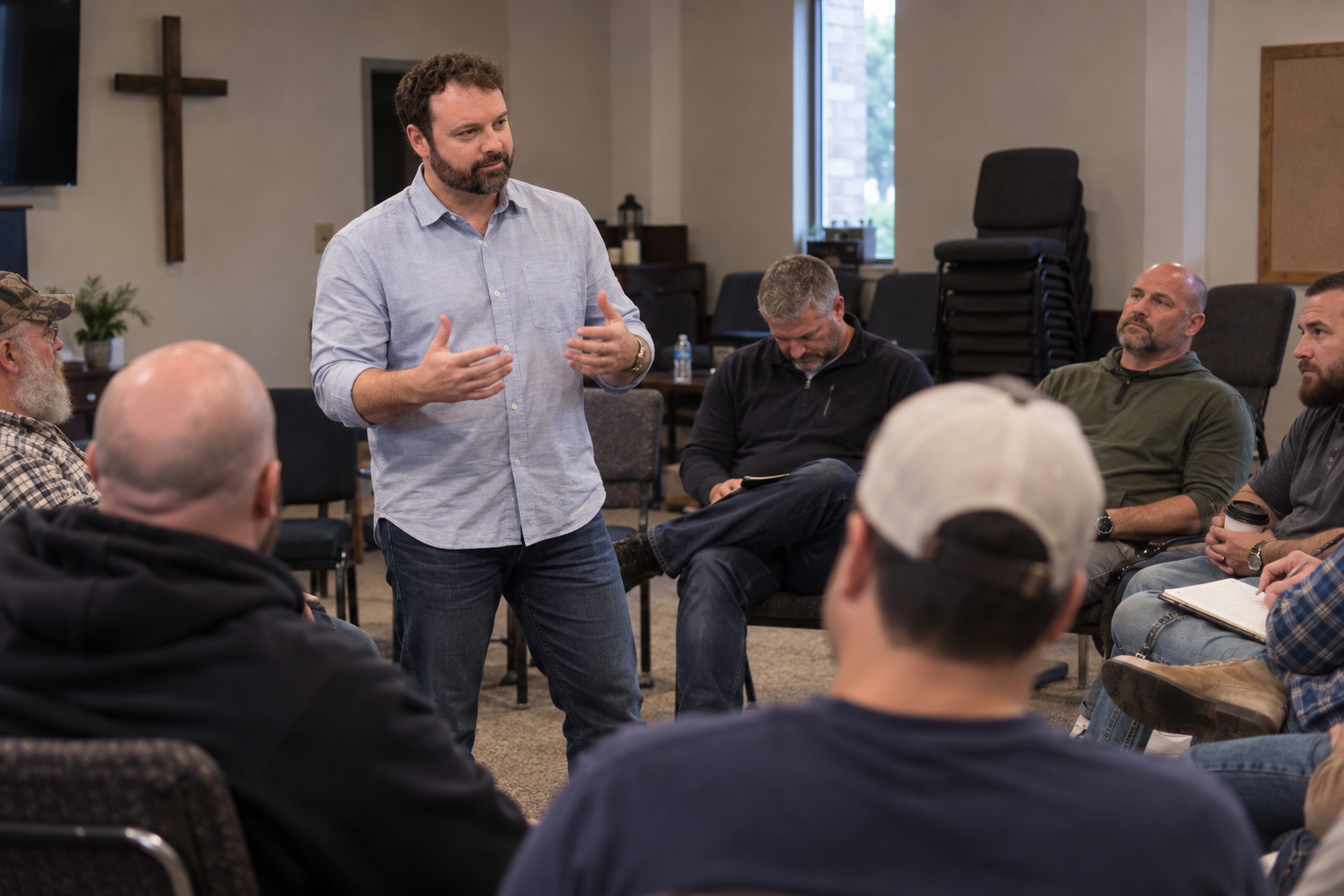
Medical claims deserve judgment by disease, patient, outcome, side effects, and unknowns before political loyalty enters the room.
The short version
Judge every medical claim at the level of the disease, stage, patient group, treatment, outcome, and timeframe.
Relative risk reductions need absolute figures, side effects, costs, and unanswered questions beside them.
Past institutional failure should sharpen scrutiny without turning resentment into a substitute for present evidence.
Faithful hope can receive medical skill, admit uncertainty, ask for a second opinion, and refuse political allegiance at the consent form.
At the European Society for Medical Oncology Congress in Madrid, one number carried the blunt force of a courtroom verdict: 58%.
Amgen’s Imdelltra, added to AstraZeneca’s Imfinzi as maintenance therapy for extensive-stage small-cell lung cancer, cut the risk of death by 58%. Median survival rose from just under 13 months to a little over 21 months.
A person living under a cancer diagnosis reads those figures differently from a campaign operative, a pharmaceutical executive, or a man firing opinions into his phone between meetings. The patient sees another birthday. Another hunting season. Another Thursday evening sitting beside somebody he loves.
Suffering has a brutal way of correcting the eyesight.
It strips the decals from our arguments. It makes slogans look cheap. It asks whether we care about truth enough to disappoint our own side.
Twenty-One Months Has Weight
“Risk of death.”
Clinical language earns its coldness. Researchers need shared terms, defined endpoints, and numbers that survive professional scrutiny. A drug trial cannot run on sentiment, however sincere.
Yet the phrase lands inside an actual human life.
Just under 13 months can mean a calendar covered in appointments, scans, insurance letters, and conversations held in lowered voices. A little over 21 months can mean additional time with a father, brother, friend, employee, neighbor, or church member whose absence would leave a permanent indentation in the room.
That gain came from Imdelltra added to Imfinzi as maintenance therapy for extensive-stage small-cell lung cancer. The treatment question begins there, with a particular drug combination, a particular disease, and a particular stage.
Medicine lives in particulars. Tribal politics survives by erasing them.
The political mind wants a universal verdict by Thursday. Good technology. Evil technology. Brave skeptic. Captured physician. Miracle cure. Corporate plot. Pick a jersey and save yourself the exhausting work of thought.
That approach feels strong because certainty photographs well. It also collapses the moment mortality enters the room.
A man facing extensive-stage small-cell lung cancer has little use for a stranger’s ideological costume. He needs to know whether the treatment prolongs life, which side effects accompany it, whether he fits the patient population, and what remains unknown.
I cannot interpret an oncology trial with the competence of a trained specialist. I can, however, recognize the fellow who read three posts and now speaks with the serene authority of a man who personally discovered the immune system. The internet has granted tenure to everybody with a charging cable.
Humility belongs in this room. So does courage. Humility says the data require expertise. Courage says expertise remains open to questions.
Faithful judgment holds both at once. We are creatures with limits, entrusted with bodies, relationships, money, influence, and time. Stewardship requires attention. It also requires an honest admission when the terminology has outrun us.
The Endpoint Has a Face
“Recurrence-free survival.”
Merck and Moderna released Phase 3 data involving intismeran, a personalized mRNA cancer vaccine, given with Keytruda after surgery for high-risk melanoma. The combination reduced the risk of recurrence or death by 42%. It reduced the risk of cancer spreading or causing death by 38%.
At two years, 82.2% of patients receiving intismeran plus Keytruda were alive without their cancer returning. Among patients receiving Keytruda alone, the figure was 70%. Roughly 12 additional patients out of every 100 avoided recurrence or death by that point.
Read “12 additional patients” slowly.
One of them has a mortgage statement on a desk. One keeps a promise to attend a graduation. One has unfinished apologies. One is still trying to repair a relationship with his father. Another sits through an ordinary quarterly review and secretly feels grateful for the boredom.
None of those details appears in the endpoint. They still matter.
For roughly a century, attempts to make cancer vaccines work mostly failed. This became the first successful Phase 3 trial of a personalized mRNA cancer vaccine.
That sentence deserves attention without demanding worship. Successful Phase 3 data answer serious questions. They leave other serious questions standing.
Overall-survival data remain immature. Intismeran remains investigational. Its cost is unknown. Researchers still lack a settled answer about which patients benefit most. Its performance against newer strategies that provide immunotherapy before surgery also remains unknown.
Severe treatment-related side effects occurred in 14.2% of patients receiving intismeran plus Keytruda and 13.4% receiving Keytruda alone.
Those percentages belong beside the benefit figures. Hope deserves the full ledger.
A desperate man deserves hope with the footnotes attached.
False certainty abuses him in two directions. Pharmaceutical cheerleading can reduce him to a future customer. Ideological rejection can reduce him to a mascot for somebody else’s grievance. Both approaches steal his individuality.
He is a man facing a specific cancer after surgery, wondering whether microscopic disease remains. His risk belongs to him. His values belong to him. His decision deserves better than a chant.
There is tenderness in taking his fear seriously enough to tell him the whole truth. There is dignity in allowing him to hear uncertain data without treating him like a child. There is love in sitting beside him when the answer remains incomplete.
A Molecule Enters Politics
“Anything that is mRNA.”
Dana-Farber oncologist Toni Choueiri called mistrust and misinformation “a key challenge” to adoption of anything involving mRNA.
The breadth of that phrase exposes the problem. “Anything” gathers distinct diseases, products, patient groups, goals, doses, risks, and benefits into one political sack. Once tied shut, the sack gets thrown at whichever tribe happens to be speaking.
Doctors sequence a patient’s tumor and identify mutations unique to that cancer. Moderna then makes a personalized strand of mRNA containing instructions for several tumor markers. After injection, the patient’s cells briefly produce those markers. The immune system receives a biological identification file for the cancer.
Keytruda helps release a brake that can keep immune cells from attacking cancer.
That application involves a patient with high-risk melanoma after surgery. A respiratory-virus vaccine given to a healthy young adult presents a separate disease, patient population, goal, baseline risk, and tolerance for side effects.
The shared technology answers none of those distinctions by itself.
A hammer can frame a wall or flatten a thumb. The existence of my thumb injury would hardly justify a federal campaign against hammers. It would justify questions about who handed me the hammer.
This is where men lose their footing. We remember institutional arrogance. We remember mandates, evasive language, moving standards, and people treating honest questions as moral defects. Then memory becomes a substitute for present judgment.
Memory should sharpen scrutiny. Resentment dulls it.
The man trying to learn how to judge a medical claim needs five concrete questions:
- Which disease and stage were studied?
- Which patients received the treatment?
- Which outcome changed, and during what timeframe?
- Which serious side effects occurred?
- Which answers remain unavailable?
Those questions refuse allegiance to both the pharmaceutical brochure and the viral post. They also require work, which explains why slogans maintain such a profitable career.
I prefer a clean villain when I can get one. He saves time. He also tends to disappear when the patient data arrive.
Moral seriousness begins when the villain costume comes off and the particulars remain. Merck and Moderna have commercial interests. Patients have lives at stake. Physicians carry expertise and fallibility. Government agencies hold power. Political organizations pursue influence. Every participant deserves scrutiny proportionate to the authority being exercised.
A man who distrusts institutions still owes the truth his loyalty.
The Ban Arrives in Capital Letters
“Ban mRNA.”
Last month, Americans for Health Freedom called on President Donald Trump and Health Secretary Robert F. Kennedy Jr. to ban mRNA and gene-therapy-derived technologies for all vaccines. The organization described the technologies as an “abject failure” in safety and efficacy.
The word “all” does the heavy lifting. It also hides the body.
A universal ban treats the platform as the verdict. The Phase 3 melanoma data concern a personalized product used with Keytruda after surgery for high-risk melanoma. The call for a ban sweeps across applications through the category itself.
Such language appeals to anyone exhausted by evasions from agencies, corporations, media institutions, and politicians. Exhaustion is real. It carries no medical credential.
The central question concerns the standard used for judgment. If a specific product failed a specific patient group on safety or efficacy, name the product, patient group, endpoint, and evidence. If regulators exceeded their authority, identify the decision. If mandates violated conscience or bodily autonomy, argue that question directly.
Category-wide condemnation offers emotional efficiency. It grants the speaker certainty without the inconvenience of separating respiratory infections from melanoma.
The same error appears on the other side. One successful Phase 3 trial of intismeran cannot cleanse every decision made during the COVID-19 pandemic. It cannot settle disputes involving mandates, boosters, or the benefit offered to different populations by specific infectious-disease vaccines.
A melanoma result answers a melanoma question.
That discipline infuriates people who have built identities around total vindication. They want one dataset to acquit their entire team and convict everybody across the aisle. Oncology declines the assignment.
Human bodies are stubborn that way. They keep refusing to register with a political party.
Government also deserves direct scrutiny. Last year, Kennedy’s Department of Health and Human Services wound down 22 mRNA vaccine development investments at the Biomedical Advanced Research and Development Authority, known as BARDA. Those investments concerned mRNA vaccines for respiratory infections, rather than cancer.
The distinction protects honest criticism. A policy directed at respiratory-infection research cannot automatically be described as a cancer-policy decision. It can still raise questions about future platform research, institutional priorities, and how broadly officials apply their reasoning.
Specificity keeps an argument from turning into propaganda.
Ask which 22 investments were wound down. Ask what stage each investment had reached. Ask which evidence supported the decision. Ask what contractual obligations remained. Ask whether the reasoning applied to one use of mRNA or reflected a wider institutional judgment.
Vague opposition gives government room to expand later. Vague praise does the same. Every bureaucracy loves a citizen who argues in adjectives.
The Fine Print Belongs Up Front
“Overall-survival data.”
Those data remain immature for intismeran plus Keytruda. That fact limits the conclusion. The Phase 3 result showed improvement in recurrence-related endpoints, including a 42% reduction in the risk of recurrence or death and a 38% reduction in the risk of spreading or death. It has yet to establish that patients live longer overall.
This distinction sounds technical until your own name sits on the file.
Recurrence-free survival matters. Overall survival matters. Severe treatment-related side effects matter. Cost matters. Access matters. The sequencing and manufacturing of a personalized therapy matter. Comparison with immunotherapy before surgery matters.
The current data provide meaningful answers and visible blanks.
A serious physician can explain both. A serious patient can ask about both. A serious man supporting somebody through cancer can write the answers down, request plain language, and resist converting fear into immediate certainty.
He can ask:
- Did the trial compare the proposed treatment with the current option I would otherwise receive?
- Does my disease match the high-risk melanoma population studied after surgery?
- What does the two-year result say about recurrence?
- What does the trial currently establish about living longer overall?
- How do the severe treatment-related side-effect rates of 14.2% and 13.4% apply to this decision?
- Which costs will fall on me, my family, my insurer, or another payer?
The answer to that final question remains unknown for intismeran. Cost can turn a laboratory advance into a bank-lobby crisis. Men deserve direct language about deductibles, coverage decisions, travel, time away from work, and the financial obligations attached to treatment.
Provision has a moral dimension. A patient choosing treatment carries concern for his own life and concern for people connected to him. Some men will pursue every available month. Others will place heavier weight on side effects, finances, physical function, or time outside medical facilities. Their decisions demand attention to conscience and facts.
No spreadsheet can carry the entire burden. A P and L statement records dollars. It cannot record the sound of a son hearing his father’s diagnosis. A clinical endpoint records recurrence. It cannot record the quiet relief of an ordinary scan.
Faith gives us no permission to falsify uncertainty. Prayer and evidence belong in the same life. So do hope and consent. So do physicians, second opinions, honest questions, and the sober recognition that every life eventually reaches a boundary medicine cannot move.
Faithful hope can survive an unfinished dataset.
Your Tribe Cannot Sign the Consent Form
“A key challenge.”
Toni Choueiri’s warning about mistrust reaches beyond mRNA. Trust in medicine is earned patient by patient, explanation by explanation, disclosure by disclosure.
Institutions damaged that trust whenever they used authority as a substitute for persuasion. Public officials damaged it whenever political goals shaped their language. Corporations damaged it whenever commercial interest hid behind humanitarian polish. Citizens damaged it whenever suspicion hardened into a refusal to examine evidence.
The bill arrives in the oncology office.
Some clinicians have moved away from using the word “vaccine” for products such as intismeran, preferring language such as personalized cancer therapy. That shift reveals the power attached to a label. It also raises a fair question: Does the new phrase improve precision, or does it avoid political resistance?
Intismeran uses mRNA carrying instructions for tumor markers unique to a patient’s cancer. That mechanism deserves a direct explanation. Renaming it solely to slip past public distrust trades one communications problem for another.
Plain speech serves the patient. Tell him what enters his body. Tell him what the cells briefly produce. Tell him how Keytruda affects the immune response. Tell him what Phase 3 showed at two years. Tell him what remains investigational. Tell him that overall-survival data remain immature.
Then let the man ask hard questions without punishing him for the last several years.
That last part matters. Sneering at skepticism will deepen it. Treating every concern as proof of ignorance turns the consultation into a disciplinary hearing. Respect makes room for informed consent. Contempt makes room for another phone screen.
Patients carry memories into these decisions. Some remember being dismissed. Some remember losing family members. Some remember treatments that helped. Some remember treatments that failed. Some trust their physicians deeply. Others arrive with a stack of printouts and the emotional temperature of a hostile board meeting.
They remain complicated people facing frightening choices.
A physician carries complexity too. He has training, experience, limited time, professional pressures, and a duty to the person across from him. His expertise deserves respect. His recommendation still needs explanation.
Neither white coat nor podcast microphone grants infallibility. One at least comes with supervised training.
For a man confronting mortality, the practical discipline is severe: refuse the answer supplied by party loyalty. Write down the disease, stage, treatment, comparison group, endpoint, timeframe, side effects, unknowns, and cost. Ask the oncologist which finding applies directly to your condition. Ask which finding came from a different use of the same technology.
Bring another person if fear has turned every sentence into static. Let that person take notes. Request the absolute figures alongside relative risk reductions when they are available. In the intismeran Phase 3 data, the two-year figures were 82.2% with intismeran plus Keytruda and 70% with Keytruda alone.
Those numbers offer firmer ground than a party slogan. They still leave an individual decision to be made.
The Chair Across From the Oncologist
“Investigational.”
That single word carries the final restraint. Intismeran remains investigational. Its cost remains unknown. The patients most likely to benefit have yet to be fully identified. Comparison with immunotherapy before surgery remains unresolved. Overall-survival data remain immature.
And the Phase 3 findings remain significant.
Holding those facts together requires maturity. Our culture rewards the opposite. Social platforms reward fury. Political organizations reward loyalty. Corporations reward favorable narratives. Government agencies reward compliance with institutional priorities. A suffering man needs truth from all of them and receives incentives instead.
His mortality can clarify what the institutions blur.
He does not need mRNA to be pure or cursed. He needs a judgment about intismeran with Keytruda after surgery for high-risk melanoma. He needs the 42%, the 38%, the 82.2%, the 70%, the 14.2%, and the 13.4%. He needs the unknown cost and immature overall-survival data placed beside them.
He needs room for hope without being sold certainty.
The Christian posture here begins with humility before truth. Our bodies are finite. Our knowledge is partial. Human skill can relieve suffering, extend life, and uncover remarkable mechanisms inside cells. Human institutions can distort, overreach, conceal, and congratulate themselves in the same quarter.
Grace frees a man from defending every past opinion as though salvation depended on his consistency. He can question one mRNA application and consider another. He can oppose coercion and support voluntary treatment. He can distrust an agency and still examine data produced under regulatory oversight. He can thank God for skilled physicians while asking them direct questions.
Conviction without humility becomes another form of fear.
The man in the oncology office may have spent years reposting claims, mocking the other tribe, or avoiding the subject entirely. Cancer has no interest in preserving his persona. The scan sits before him. The consent form waits. Somebody he loves has gone quiet in the chair beside him.
Madrid feels very far away.
Just under 13 months. A little over 21 months. Two years without recurrence for 82.2% instead of 70%. Numbers from companies and clinicians, carried into a small room where one human being has to decide what hope is allowed to cost.
He reaches for the pen, then sets it down again.
What to do about it
This week, take one medical claim you have repeated or believed and trace it to the specific disease, stage, patient group, comparison, outcome, and timeframe. Write down every missing item instead of filling the blank with suspicion or enthusiasm.
If a treatment decision is near, ask the physician for absolute figures alongside relative risk, then record serious side effects, unresolved questions, expected costs, and the option you would otherwise receive. Bring a trusted person to take notes when fear makes details hard to hold.
Kill the habit of forwarding medical claims before reading beyond the headline. Set the phone face down beside the consent form until the particulars have spoken.
Faith. Finance. Focus.
Strong Men. Strong Homes. Strong Businesses.
Discover More: mrwhatley.com
All My Links: mrwhatley.com/connect
Ready to Be a Better Man? mrwhatley.com/check-in
Free Course: mrwhatley.com/free